
Numerous studies, both academic and financial, have found dividends accounted for more than 60% of total U.S. stock market returns since 1870.
More recently, a study by Ned Davis Research covering the period from 1972 through 2008 found that dividend-paying stocks provided an annual return of 7.6% versus a mere 0.2% for non-dividend-paying shares.
What's more, companies with a record of steadily raising their dividends returned an even more impressive 8.6%.
But if you really want to boost your returns, investing in DRIPs - dividend reinvestment plans --is a safe, steady road to building true wealth.
What is a DRIP? Dividend reinvestment plans, or DRIPs, are special programs sponsored by corporations that allow shareholders to immediately reinvest their dividend payouts back into the company's common stock.<br />
The best part is that it usually can be done without brokerage commissions or fees, and is often at a 3%-5% discount to the current market price. Sometimes that discount is as high as 10%.
Most company-sponsored DRIPs have a minimum of just $10 for reinvestment, and allow accumulation of fractional shares. That means even small stockholders can easily participate in DRIPs.
Some of the leading corporations that sponsor their own DRIP programs include: Caterpillar Inc. (NYSE: CAT), The Coca-Cola Co. (NYSE: KO), Exxon Mobil Corp. (NYSE: XOM), General Electric Co. (NYSE: GE), Goodyear Tire & Rubber Co. (NYSE: GT), The Hershey Company (NYSE: HSY), Texas Instruments Inc. (NYSE: TXN), Yahoo! Inc. (Nasdaq: YHOO) and many others. Roughly 1,125 U.S. stocks offer DRIPs.
In addition, for a modest fee - usually $5 per transaction or less - most brokerage firms and numerous DRIP advisory services can set up and manage dividend-reinvestment plans, known as "synthetic DRIPs," for shareholders of leading companies that don't offer plans of their own, as well as for many of the top exchange-traded funds (ETFs).
What's more, nearly every regular mutual fund offers automatic dividend reinvestment plans for their shareholders.
The Compounding Value of DRIP Investing The biggest advantage of participating in a DRIP program is that it provides low-cost compounding of your investment dollars, allowing you to accumulate more shares and increase the value of your position at a faster rate-- even when the price of the stock itself doesn't do as well as you might have hoped.
This advantage was clearly spelled out in the book "Triumph of the Optimists: 101 Years of Global Investment Returns," which found that, over the course of the 20th century, a portfolio with dividends reinvested would have generated nearly 85 times the wealth of the same portfolio relying solely on capital gains for growth.
For instance, check out the following two scenarios involving the stock of Johnson & Johnson (NYSE: JNJ), which was recently recommended in a Money Morning story on defensive investing.
Johnson & Johnson pays an annual dividend of $2.28 a share, or 57 cents per quarter. In this case, let's assume you start off by buying 200 shares of JNJ stock at $65 per share, or $13,000.
Here's how your JNJ investment could play itself out:
Scenario 1: JNJ Without a DRIP
Over the course of two years, JNJ's stock price could fluctuate but wind up right back where you started, at $65 per share. If so, you would receive $114 per quarter in dividend payments. But without a DRIP you would collect and spend the entire $912, leaving you with no capital gain and a position still worth just $13,000.
Scenario 2: JNJ With a DRIP
However, the results are very different if you decide to enroll in JNJ's dividend reinvestment plan, which allows you to convert each quarterly payment into new shares at the market price, with no commissions and a reinvestment fee of just $1 per transaction. Again, let's assume the stock fluctuates, but winds up right where it started, at $65 per share, after two years.
But, because of the DRIP, the number of shares you hold increases along with the value of your position. It works as follows:
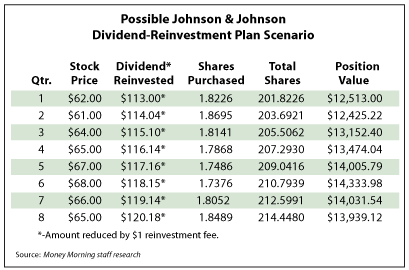
As you can see, by participating in JNJ's DRIP, you've accumulated 14.448 additional shares, upping your quarterly payout by more than $7 and lifting the total value of your position by $939.12 - even though the stock price ended up exactly unchanged from two years earlier.
The Lowdown on DRIPs Other DRIP advantages include the ability to acquire fractional lots - and even fractional shares - rather than having to wait until you have enough money for a "round lot" (100 shares) or full-share purchase.
In addition, many companies with DRIPs also offer what are known as "direct-stock investment plans" (DSPs). These allow existing shareholders to purchase additional shares directly from the company, in small or large quantities, again without a commission or other fees.
They also provide many ancillary services, such as Individual Retirement Accounts (IRAs), monthly and/or weekly purchase plans and telephone redemptions.
More than 600 companies also offer so-called "no-load" stock plans, which allow you to make your initial share purchase directly from the company, without commissions. However, many of these plans are restricted - often to company customers or residents of the corporation's home state.
Of course, DRIPs also have a few negatives, but these fall mostly into the category of inconveniences rather than threats to your investment success.
For starters, most corporate DRIP plans require you to become a "registered shareholder" rather than a "beneficial shareholder." That simply means you must be a direct owner of the company stock and listed with its transfer agent rather than having your shares held by your broker or other proxy in so-called "street name."
In the past, this meant having to receive and safeguard the actual stock certificates, but today almost all direct ownership is handled via electronic bookkeeping entries, with no certificates needed (unless you want them).
Another irritation is that, even though you don't actually withdraw your quarterly dividend payments, the IRS still requires you to pay taxes on them in the year they are received.
Perhaps the most onerous inconvenience is the need to keep track of the cost basis for each of the many small share purchases you make when you reinvest your dividends. You'll need this information to calculate your capital gains and your tax liability when you eventually sell the shares.
This doesn't sound like a major problem since you only get four dividends a year, but if you use DRIPs on 10 stocks for five years, it adds up to 200 small purchases you'll have to account for when you sell.
You'll also have to make multiple adjustments in the event of stock splits, spin-offs or mergers.
It's a bit of a headache, but the benefits of DRIP investing in terms of growing your wealth far outweigh the inconveniences.
If you want to know whether a company whose stock you already own (or are interested in buying) offers a DRIP plan, you can contact the Shareholder Services or Investor Relations department of the corporation. Numbers and addresses are available in the company's annual reports, on its Website or in the "Profile" section of most online quote-service listings.
They'll be happy to advise you regarding the availability of DRIP, "no-load" or DSP purchase plans and what you need to do to enroll.
If the company itself doesn't sponsor a plan, you can also check with your broker to see if their firm supports a synthetic DRIP program for clients, or you can check with one of the leading DRIP advisory firms, all of which can quickly answer your questions, advise you regarding fees, and help you open an account.
You can get contact information for five of the top DRIP services by clicking on the following links:
- DRIP Investor - dripinvestor.com
- DRIP Advice - dripadvice.com
- Direct Investing - directinvesting.com
- DRIP Wizard- dripwizard.com
- DRIP Central - dripcentral.com
Related Articles and News:
- Money Morning:
Four Defensive Stocks for a Market Pullback - Wikipedia:
Encyclopedia entry: Dividend reinvestment plan - Investopedia:
The Perks of Dividend Reinvestment Plans
Tags: dividend reinvestment plan, dividend reinvestment plan list, dividend reinvestment plans, dividend stocks, drip companies, drip definition, drip investing companies, drip investing wiki, drip mutual funds, drip stock investing, DRIP Stocks, DRIPs, ividend reinvestment plan companies
