HPCwire

Since 1986 - Covering the Fastest Computers
in the World and the People Who Run Them

Language Flags

Visit additional Tabor Communication Publications

Datanami
Digital Manufacturing Report
HPC in the Cloud
Green Computing Report

Tabor Communications
Corporate Video

HPC Market Watch


Is Apple Inc.'s (Nasdaq: AAPL) Bet on Liquidmetal About to Pay Off?
Apple Inc. (Nasdaq: AAPL ) loves to think of lucrative new uses for other people's bright ideas. For instance, the original iPod wouldn't have been possible without Toshiba's innovative 1.8-inch hard drive. And when Steve Jobs learned about Gorilla Glass in 2006, he convinced Corning to revive the largely unused technology so Apple could put it in the iPhone. So it's no surprise that Apple has been toying with yet another breakthrough technology. It's called Liquidmetal. Liquidmetal is a family of metal alloys that combines a variety of metallic elements. It's a technique that rapidly cools the mixture into a "metallic glass" with a distinctly different molecular structure than conventional metals. It becomes amorphous, as opposed to crystalline. That amorphous structure is the secret behind Liquidmetal's many remarkable properties. Now imagine what Apple could do with a material that: Is five times as strong as aluminum and twice as strong as titanium; Is three times as elastic as ordinary metals; Is highly resistant to corrosion; Is highly resistant to scratching and wear; Has a fingerprint-resistant, glossy finish that needs no polishing; And can be blow-molded like glass or injection-molded like plastic. And while most of the basic ingredients of Liquidmetal -- zirconium, titanium, nickel, copper, and beryllium -- remain the same, adjustments to the ratios and manufacturing process can customize the alloy for many different purposes. Invented in 1992 as part of a joint project between NASA, the California Institute of Technology and the U.S. Department of Energy, Liquidmetal creates vast new possibilities - particularly in the hands of a company as innovative and resource-rich as Apple. As NASA's web page for spinoff technologies puts it: "In the same way that the inventions of steel in the 1800s and plastic in the 1900s sparked revolutions for industry, [this] new class of amorphous alloys is poised to redefine materials science as we know it in the 21st century." To continue reading, please click here...
Apple Inc. (Nasdaq: AAPL) loves to think of lucrative new uses for other people's bright ideas.

For instance, the original iPod wouldn't have been possible without Toshiba's innovative 1.8-inch hard drive.

And when Steve Jobs learned about Gorilla Glass in 2006, he convinced Corning to revive the largely unused technology so Apple could put it in the iPhone.

So it's no surprise that Apple has been toying with yet another breakthrough technology.

It's called Liquidmetal.

Liquidmetal is a family of metal alloys that combines a variety of metallic elements. It's a technique that rapidly cools the mixture into a "metallic glass" with a distinctly different molecular structure than conventional metals. It becomes amorphous, as opposed to crystalline.

That amorphous structure is the secret behind Liquidmetal's many remarkable properties.

Now imagine what Apple could do with a material that:

  • Is five times as strong as aluminum and twice as strong as titanium;
  • Is three times as elastic as ordinary metals;
  • Is highly resistant to corrosion;
  • Is highly resistant to scratching and wear;
  • Has a fingerprint-resistant, glossy finish that needs no polishing;
  • And can be blow-molded like glass or injection-molded like plastic.
And while most of the basic ingredients of Liquidmetal -- zirconium, titanium, nickel, copper, and beryllium -- remain the same, adjustments to the ratios and manufacturing process can customize the alloy for many different purposes.

Invented in 1992 as part of a joint project between NASA, the California Institute of Technology and the U.S. Department of Energy, Liquidmetal creates vast new possibilities - particularly in the hands of a company as innovative and resource-rich as Apple.

As NASA's web page for spinoff technologies puts it:

"In the same way that the inventions of steel in the 1800s and plastic in the 1900s sparked revolutions for industry, [this] new class of amorphous alloys is poised to redefine materials science as we know it in the 21st century."

The Story of Liquidmetal Technologies Inc. (OTC: LQMT) The technology belongs to the aptly named Liquidmetal Technologies Inc. (OTC: LQMT), a company formed more than two decades ago to commercialize the new material.

In contrast to the promise of its technology, Liquidmetal is tiny. With no factory of its own, Liquidmetal enlists partners to manufacture customized parts for customers. It has fewer than 20 employees and its market cap recently slipped below $50 million. The stock has been trading below $0.50 lately and tends to be volatile.

And yet as the owner of the intellectual property, Liquidmetal appears to be sitting on a gold mine. Liquid metalStill, Liquidmetal's attempts to commercialize its product met with mixed success until Apple came along.
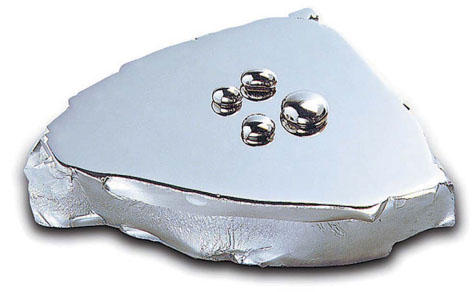
Intrigued by Liquidmetal's unusual properties, Apple made a deal with the company in 2010 to secure exclusive worldwide rights to use the alloy in consumer electronics products. Liquidmetal retains the right to license its technology to other industries, such as defense or medical.

"They have been working with Apple for a long time," Drew Merkel, one of Liquidmetal's biggest investors, told the Cult of Mac Website back in 2010. "They were making prototypes, trying to land a big fish."

Apple Senior Vice President for Industrial Design Jonathan Ive, whose enthusiasm for alternative materials and manufacturing processes is well known, is said to be particularly fascinated by Liquidmetal.

So far, not much has come of the relationship - Apple's only confirmed use of Liquidmetal is the SIM card removal tool included with some versions of the iPhone.

But that's likely to change soon.

What Apple Could Do With Liquidmetal Apple would not have invested more than $20 million - that was just the upfront fee it paid Liquidmetal in 2010 - simply to build a better SIM card removal tool.

Recent rumors out of Korea have suggested Apple will use Liquidmetal to make the outer case of the iPhone 5, which is expected to launch in October.

But such possibilities were being discussed as far back as 2010.

"I think they're going to make the iPhone out of it," Dr. Jan Schroers, a former director of research atLiquidmetal who is now an Associate Professor of Mechanical Engineering & Materials Science at the Yale School of Engineering and Applied Science, told Cult of Mac. "It's quite obvious from what Liquidmetal has done in the past and what the technology is capable of."

Obviously a metal with exceptional strength and durability, not to mention a silky-smooth, smudge-resistant finish, would suit the iPhone 5 perfectly.

"The next iPhone needs to truly stand out from the crowd," Canalys analyst Chris Jones told Wired. "A change in materials is a likely way to differentiate its form factor."

Schroers said Liquidmetal could also be used to build remarkably thin, strong seamless frames for other Apple products, such as MacBooks, iPads or big screen displays. For that matter, it would make an ideal frame for the much-anticipated Apple iTV.

Apple could even etch its logo as a holographic image into the alloy. How cool is that?

Liquidmetal's unusual properties also make it a good candidate for a wide assortment of other components, such as an iPhone antenna, parts of rechargeable batteries and laptop hinges.

A Waterproof iPhone 5? But perhaps the most significant possible use of Liquidmetal in an Apple product is for waterproofing mobile devices such as the iPhone.

Last year Crucible Intellectual Property, the Liquidmetal subsidiary formed in the 2010 deal to work with Apple, filed a patent covering the use of the alloy as a waterproof sealant.

According to the Patently Apple Website, the patent says the process could be used in "a telephone, such as a cellphone, and a land-line phone, or any communication devices, such as a smartphone, including, for example, aniPhone.Other listed devices includean electronic email sending/receiving device or be a part of a display, such as a digital display,a TV monitor, an electronic-book reader, an iPad and a computer monitor."

Apple itself had earlier filed for a patent on a different method for waterproofing mobile devices, so it's clearly determined to add it as a feature one way or another.

To anyone who's ever dropped their iPhone into a swimming pool, bathtub or toilet, such news will be welcome indeed.

And with Liquidmetal in Apple's arsenal, a waterproof iPhone may be only the beginning.

"It is hard to predict what will come, when you leave such a technology to the imagination and creativity of Apple product development and innovation," Dr. Atakan Peker, a former vice president of research at Liquidmetal, told Cult of Mac. "I won't be surprised with some very interesting [Liquidmetal-using] products in the future."

Related Articles and News:


Tags: AAPL, Apple stock, Apple Stock (Nasdaq: AAPL), apple stock price, Nasdaq: AAPL Stock
Stock Market XML and JSON Data API provided by FinancialContent Services, Inc.
Nasdaq quotes delayed at least 15 minutes, all others at least 20 minutes.
Markets are closed on certain holidays. Stock Market Holiday List
By accessing this page, you agree to the following
Privacy Policy and Terms and Conditions.
Press Release Service provided by PRConnect.
Stock quotes supplied by Telekurs USA
Postage Rates Bots go here

Sponsored Links

Accelerate your science with Seneca
One of the first HPC providers installing a 4X NVIDIA Kepler K-20 cluster. Invites you to a free evaluation on Seneca’s NVIDIA K20 Kepler cluster, pre-loaded with AMBER, NAMD, LAMMPS

High-Performance Computing in Action
Businesses that want to be on the cutting edge of their industries are increasingly turning to high-performance computing (HPC) solutions to handle complex compute processes and speed up their rate of innovation. Download this Executive Brief to see how businesses in energy, life sciences and entertainment put HPC solutions to work in their operations.

May 17, 2013

May 16, 2013

May 15, 2013

May 14, 2013

May 13, 2013

May 10, 2013

May 09, 2013

May 08, 2013

May 07, 2013

May 06, 2013


Cray CS300-LC

Feature Articles

Saddling Phi for TACC’s Stampede

The Xeon Phi coprocessor might be the new kid on the high performance block, but out of all first-rate kickers of the Intel tires, the Texas Advanced Computing Center (TACC) got the first real jab with its new top ten Stampede system.We talk with the center's Karl Schultz about the challenges of programming for Phi--but more specifically, the optimization...
Read more...

"No Exascale for You!" An Interview with Berkeley Lab's Horst Simon

Although Horst Simon was named Deputy Director of Lawrence Berkeley National Laboratory, he maintains his strong ties to the scientific computing community as an editor of the TOP500 list and as an invited speaker at conferences.
Read more...

Supercomputing Vet Champions Quantum Cause

Supercomputing veteran, Bo Ewald, has been neck-deep in bleeding edge system development since his twelve-year stint at Cray Research back in the mid-1980s, which was followed by his tenure at large organizations like SGI and startups, including Scale Eight Corporation and Linux Networx. He has put his weight behind quantum company....
Read more...

Short Takes

Running Computational Fluid Dynamics in the Cloud

May 16, 2013 | When it comes to cloud, long distances mean unacceptably high latencies. Researchers from the University of Bonn in Germany examined those latency issues of doing CFD modeling in the cloud by utilizing a common CFD and its utilization in HPC instance types including both CPU and GPU cores of Amazon EC2.
Read more...

Computing the Physics of Bubbles

May 15, 2013 | Supercomputers at the Department of Energy’s National Energy Research Scientific Computing Center (NERSC) have worked on important computational problems such as collapse of the atomic state, the optimization of chemical catalysts, and now modeling popping bubbles.
Read more...

Internet2 Awards Program Seeks Innovative Applications

May 10, 2013 | Program provides cash awards up to $10,000 for the best open-source end-user applications deployed on 100G network.
Read more...

Floating Funding to Exascale Island

May 09, 2013 | The Japanese government has revealed its plans to best its previous K Computer efforts with what they hope will be the first exascale system...
Read more...

HPC and the True Cost of Cloud

May 08, 2013 | For engineers looking to leverage high-performance computing, the accessibility of a cloud-based approach is a powerful draw, but there are costs that may not be readily apparent.
Read more...

Sponsored Whitepapers

Best Practices in Big Data Storage

05/10/2013 | Cleversafe, Cray, DDN, NetApp, & Panasas | From Wall Street to Hollywood, drug discovery to homeland security, companies and organizations of all sizes and stripes are coming face to face with the challenges – and opportunities – afforded by Big Data. Before anyone can utilize these extraordinary data repositories, however, they must first harness and manage their data stores, and do so utilizing technologies that underscore affordability, security, and scalability.

Progress in Parallel: the Bull Parallel Programming Center

04/15/2013 | Bull | “50% of HPC users say their largest jobs scale to 120 cores or less.” How about yours? Are your codes ready to take advantage of today’s and tomorrow’s ultra-parallel HPC systems? Download this White Paper by Analysts Intersect360 Research to see what Bull and Intel’s Center for Excellence in Parallel Programming can do for your codes.

Sponsored Multimedia

SGI DMF ZeroWatt Disk Solution

In this demonstration of SGI DMF ZeroWatt disk solution, Dr. Eng Lim Goh, SGI CTO, discusses a function of SGI DMF software to reduce costs and power consumption in an exascale (Big Data) storage datacenter.

Cray CS300-AC Cluster Supercomputer Air Cooling Technology Video

The Cray CS300-AC cluster supercomputer offers energy efficient, air-cooled design based on modular, industry-standard platforms featuring the latest processor and network technologies and a wide range of datacenter cooling requirements.

SC12 Editorial Feature HPCwire Soundbite sponsored by ISC

Newsletters

Stay informed! Subscribe to HPCwire email Newsletters.

HPCwire Weekly Update
HPC in the Cloud Update
Digital Manufacturing Report
Datanami
HPCwire Conferences & Events
Job Bank
HPCwire Product Showcases


HPC Job Bank

HPCwire Events

Featured Events


  • June 16, 2013 - June 20, 2013
    ISC'13
    Leipzig,
    Germany

  • June 17, 2013 - June 18, 2013
    Forecast 2013
    San Francisco, CA
    United States